


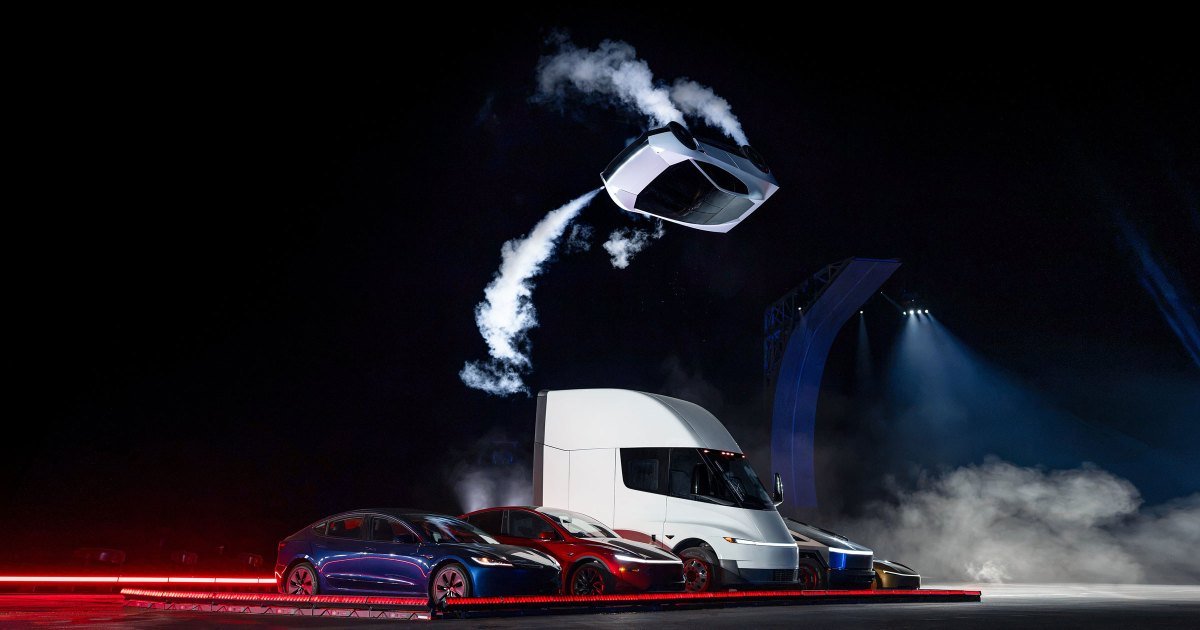
Tesla CEO Elon Musk has been promising a next-generation Roadster for the better part of a decade. And while early promises that it will quite literally fly were met with incredulity back in early 2019, the EV maker has finally made good on its promise.
As demonstrated late Thursday evening, the new Roadster can indeed fly — briefly, at least — thanks to a “SpaceX package” made up of cold-gas thrusters. The company showed the company flipping around on stage, rotating on its own axis mid-air, leaping over the company’s entire EV lineup, and sticking to a vertical ramp thanks to a fan system that generates up to two Gs of downward force.
Good luck doing any of that on a public road, or even surviving on private property. And the flying car bears a striking resemblance to the company’s controversial Cybertruck, featuring extremely sharp body lines and flat panels. It’s a low-poly design approach that feels intimately familiar after a few years of the brutalist pickups.
And the similarities aren’t limited to the overall shape, either. The Cybertruck was and still is a major outlier in the automotive landscape — mostly for the worse. From rusting stainless steel body panels that were shoddily glued to the vehicle’s exterior and an excessive curb weight that greatly reduced range to a buggy steer-by-wire system, the Cybertruck was a major departure from design norms in the industry, much like Tesla’s latest Roadster.
