


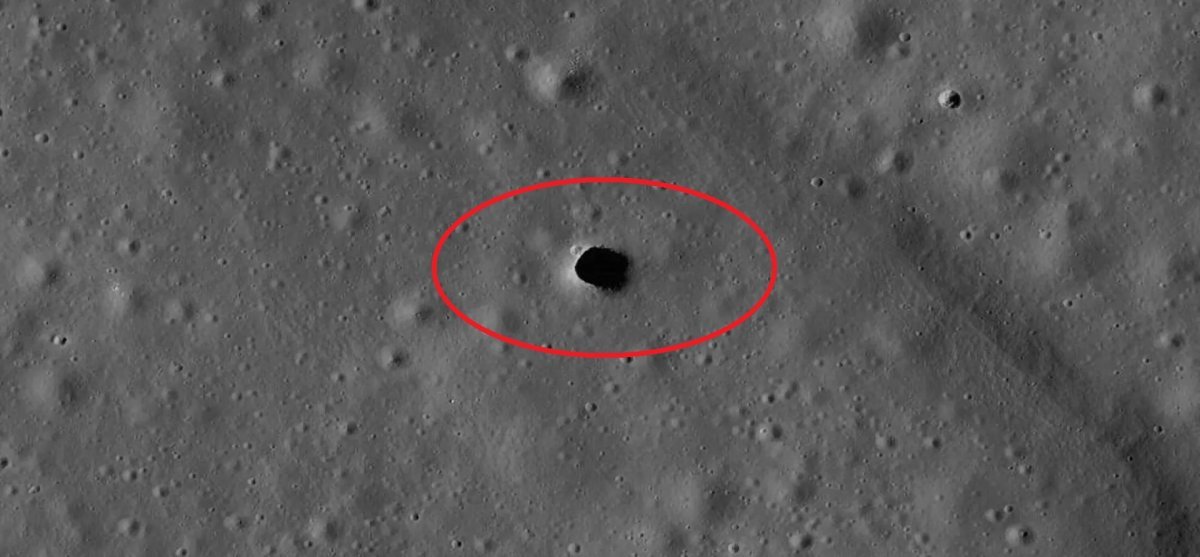
Beneath its pock-marked, craggy exterior, the Moon is thought to harbor a network of caves and tunnels from its volcanic past. Now, NASA has selected a mission to go investigate a promising window into our space rock’s subterranean secrets.
Gaping up at outer space, as if mugging for the orbital satellite cameras, is the Marius Hill Pit, a hole on the lunar surface that’s thought to be up to 150 feet deep and up to 300 feet across. Scientists believe it’s an example of a skylight — the collapsed roof of an underground lava tube, which forms a circular aperture in the ground.
If the feature is indeed a skylight, it could give scientists a peek at the Moon’s volcanic history. But scientists are also intrigued by the possibility of using these underground cavities as shelters for astronauts, or even the location of lunar bases.
Until now, the hole has only been investigated from orbit. The Geophysical Instruments for Marius Lunar pit Investigation (GIMLI) aims to do so from the ground.
