


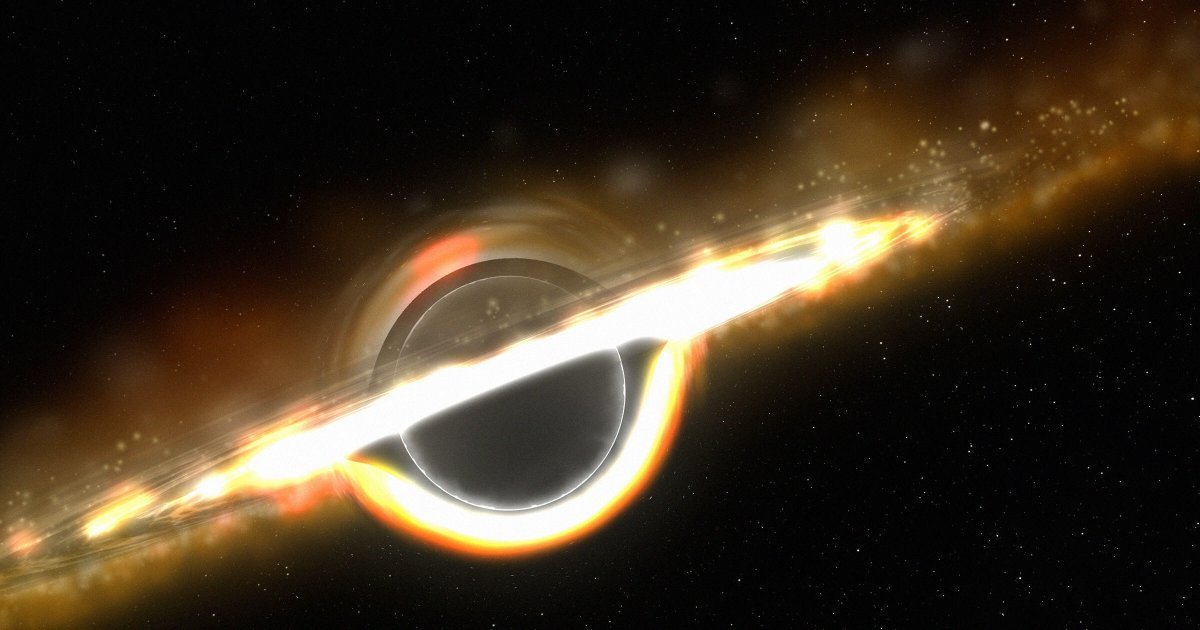
For years now, scientists have been puzzled by the existence of “little red dots” first showing up in observations by NASA’s James Webb Space Telescope. These objects appeared in a region they believe dates to just hundreds of millions of years after the Big Bang, one of the oldest known neighborhoods of the universe.
Several possible explanations have since emerged, with some arguing they could be emerging galaxies. Others suggested that the red dots could be the earliest stages of supermassive black holes, which are enormous cosmic objects that have gravitationally collapsed and are often lurking at the center of galaxies.
In a new paper published in the journal Nature this week, Max Planck Institute astrophysicist Sunmyon Chon and his colleagues delve into this possibility by simulating the earliest stages of the universe. They found that the rapidly-forming black holes could be emitting light while accreting material, appearing as the mysterious red dots, or “seeds,” picked up by the James Webb.
Despite lurking pretty much everywhere we look in our known universe, the nature of black holes remains mysterious. Scientists are still actively exploring new types of them, leaving the possibility that the red dots could be a kind we have yet to characterize.
