


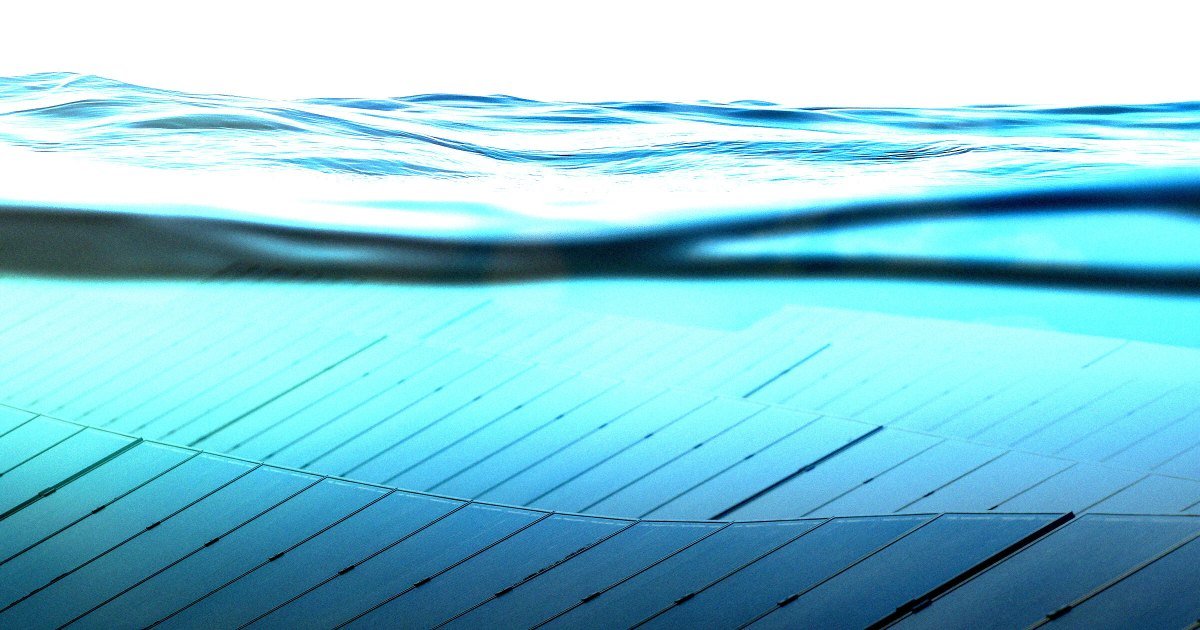
China’s green energy boom has seen solar panels plastered on the side of rainy mountains, on floating coastal platforms, and above bustling highways — and now, they’re even generating energy underwater.
According to EuroNews, scientists working near Weizhou Island on China’s southwestern coast successfully generated electricity from sunlight at a depth of 10 meters, or nearly 33 feet, a new record for photovoltaic research.
Their study, published in the research journal Joule, outlines a new type of solar panel built with perovskites — a calcium titanium oxide mineral — instead of silicon. By using pervoskite-based cells, the researchers were able to adjust the solar panels to capitalize on the kinds of blue and green sunlight waves that can penetrate the ocean’s surface.
According to the paper, the peak power conversion efficiency — a measure of how much sunlight hitting a panel is converted into usable energy — reached a high of nearly 35 percent. If true, that figure puts the panels in-line with recent breakthrough research in solar cell efficiency, and a notch above the long-established Shockley-Queisser limit, a theoretical cap which limited photovoltaic efficiency to about 33 percent.
