


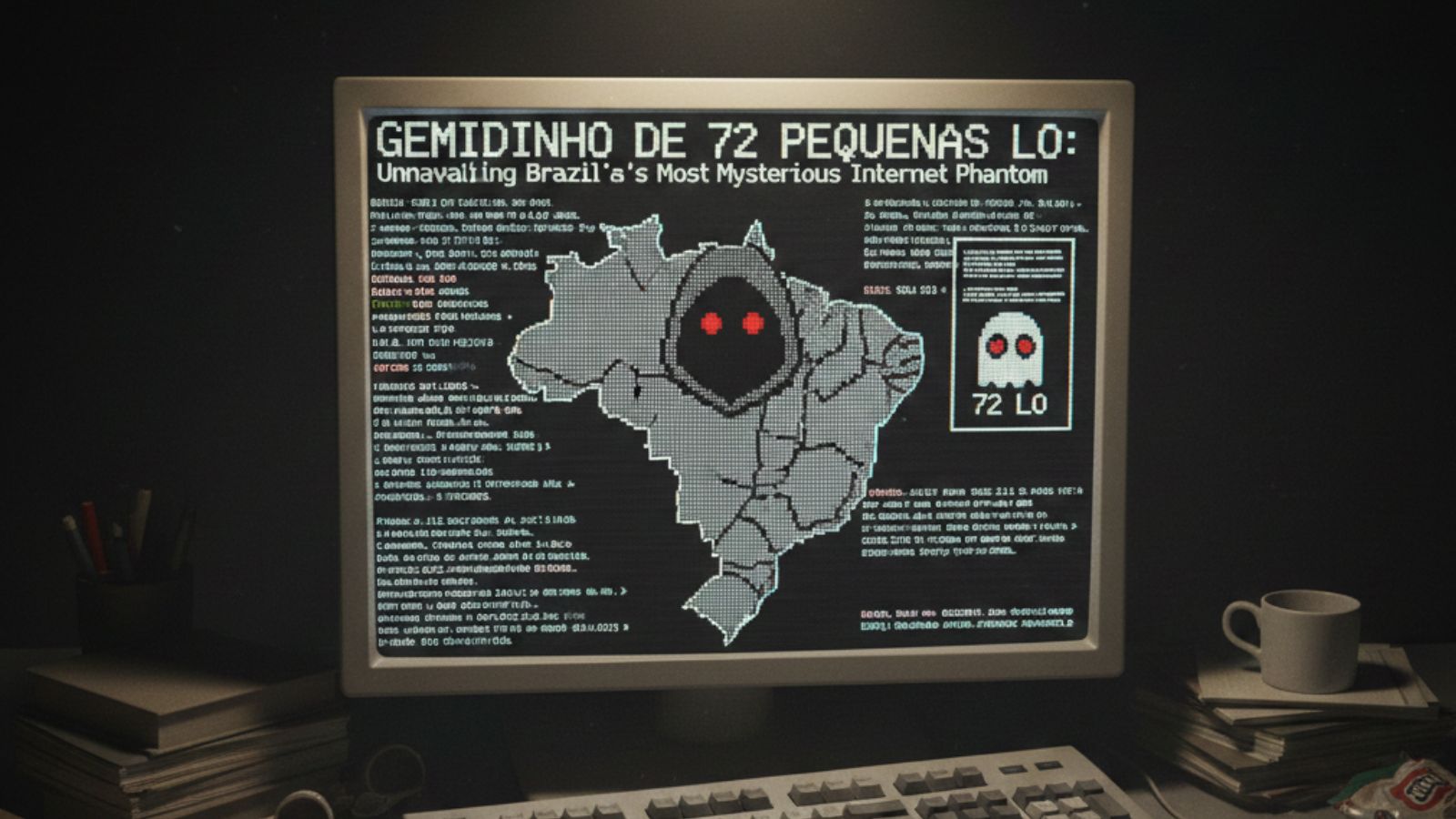
The phrase “gemidinho de 72 pequenas lo” has puzzled internet users worldwide, appearing in social media captions, search queries, and countless blog posts claiming to explain its origins. Yet despite its mysterious allure and seemingly Portuguese construction, this phrase represents something far more interesting than a viral sound or Brazilian cultural phenomenon—it’s a perfect case study in how AI-generated content and algorithmic confusion create digital phantoms that feel real but exist only in the mirror maze of modern search engines.
Understanding the Real Word: Gemidinho
Before diving into the mystery, let’s establish what’s actually Portuguese in this phrase. Gemidinho is a legitimate word—the diminutive form of “gemido,” which translates to “moan” or “groan” in English. This word appears in standard Portuguese dictionaries throughout Brazil and Portugal, and the diminutive form is commonly used in everyday speech.
The word gained international recognition through the infamous “gemidão do Zap” phenomenon that swept Brazil between 2016 and 2018. This notorious WhatsApp prank involved explicit moaning sounds hidden in seemingly innocent video clips, designed to embarrass anyone who played them in public settings. Brazilian journalists and fact-checkers traced the audio to adult film sources and documented how it infiltrated everything from government meetings to live television broadcasts.
So while gemidinho is genuine Portuguese, the rest of the phrase tells a very different story.
Deconstructing the Nonsense
When you break down “gemidinho de 72 pequenas lo” linguistically, the construction falls apart immediately. The phrase consists of mismatched fragments that create an illusion of meaning without delivering any coherent message.
“De 72” translates to “of seventy-two” but dangles without a noun to modify. In proper Portuguese, numbers require context—seventy-two what? The phrase provides no answer.
“Pequenas” means “small ones” in the feminine plural form, but again appears without the necessary noun. It’s grammatically incomplete, like saying “the small” in English without specifying small what.
“Lo” doesn’t function as idiomatic Portuguese in this position. It reads like a stray token borrowed from Spanish or potentially a hallucination from language processing models—a telltale sign of AI-generated content that mimics linguistic patterns without understanding grammar.
Together, these fragments create what linguists might call a “word salad”—elements that look Portuguese enough to seem plausible but lack the grammatical coherence of actual language.
The Content Farm Phenomenon
Search for “gemidinho de 72 pequenas lo” and you’ll encounter a bewildering array of contradictory explanations. One website claims it’s a traditional Brazilian folk dance featuring seventy-two small steps. Another insists it’s a rare gemstone from remote regions. A third presents it as a symphonic masterpiece by a composer named Alejandro Montoya. Yet another describes it as a social housing project in Belo Horizonte consisting of seventy-two small homes.
None of these explanations cite verifiable sources. None appear in Brazilian cultural databases, news archives, or academic records. None agree with each other on even the most basic facts.
This confusion isn’t accidental—it’s the predictable result of AI-powered content farms exploiting search engine algorithms. These operations generate hundreds of plausible-sounding articles targeting obscure search queries, harvesting advertising revenue from confused visitors seeking answers. Google and independent researchers have extensively documented this “parasite SEO” strategy, which exploded in 2024 as AI writing tools became more sophisticated.
The content farms follow a simple formula: identify trending or mysterious phrases, generate authoritative-sounding explanations using language models, publish rapidly across multiple domains, and wait for search traffic to arrive. Quality and accuracy become irrelevant when the goal is simply capturing attention and ad impressions.
The Viral Loop of Misinformation
Understanding how this phantom spread reveals broader patterns in digital misinformation. The cycle begins when a caption generator or text-to-speech filter produces near-Portuguese gibberish during meme creation. Curious viewers search the phrase, triggering content farms to auto-generate explanatory articles. Search engines temporarily rank these articles, lending them credibility. People then cite these articles as proof the phenomenon is real, strengthening the illusion until algorithm updates eventually downgrade the spam content.
This loop operates independently of truth. It requires no original song, tradition, or cultural artifact—only search queries and content generation systems responding to those queries.
Verifying Viral Sounds: A Practical Guide
When confronted with mysterious “viral sounds,” apply this four-step verification process. First, check the sound page on TikTok or Instagram Reels for credited artists, labels, or upload dates. Second, cross-reference any credits on Spotify, YouTube, or SoundCloud—no legitimate trail usually indicates an edited clip or fabrication. Third, search Brazilian press and music outlets in Portuguese; silence is revealing for anything claimed to be nationally significant. Fourth, examine lyrics or captions for linguistic coherence—if phrases fall apart grammatically, treat them as noise.
Applying these steps to “gemidinho de 72 pequenas lo” reveals the truth instantly. No credited artist exists. No music platforms host an original track. Brazilian media outlets have published no coverage. The phrase itself is grammatically incoherent.
Why This Matters Beyond One Phrase
The “gemidinho de 72 pequenas lo” case illustrates a larger crisis in digital information ecosystems. The internet increasingly contains what researchers call “slop”—AI-generated zombie content that imitates news, culture, and expertise without providing genuine value. Studies from Harvard Kennedy School and reports from The Guardian, Associated Press, and Google itself have documented how these synthetic pages crowd out authentic information.
For music and memes specifically, where mondegreens and joke captions are features rather than bugs, distinguishing real cultural phenomena from algorithmic phantoms becomes crucial. Without verification skills, users waste time chasing ghosts and amplify misinformation through shares and citations.
The Bottom Line
Gemidinho de 72 pequenas lo is not a Brazilian song, dance, gemstone, symphony, or housing project. It’s a linguistic chimera—one real Portuguese word (gemidinho, meaning “little moan”) combined with grammatically incomplete fragments that AI content systems have dressed up as culture, history, and art.
The only genuine “viral sound” in this neighborhood is the original gemidão do Zap prank, which shares nothing with this phrase except a root word. Everything else represents the intersection of algorithmic confusion, content farm exploitation, and human pattern-recognition instincts creating meaning where none exists.
When friends insist they’ve heard this everywhere, ask for the original sound page—not a reupload or meme edit. The trail inevitably ends with joke captions and AI blog posts masquerading as expertise. That’s not culture. That’s noise pretending to have a story worth telling.
